
If you run a retail business, an e-commerce store, or a warehouse in Singapore, you already know the feeling.
One moment, you’re staring at empty shelves, losing sales during an 11.11 sale. Next, you’re drowning in excess stock of a product that stopped moving after Chinese New Year.
Inventory problems usually come down to three things:
- Ordering too much: Cash gets tied up in slow movers
- Ordering too little: You miss sales and frustrate customers
- Not seeing demand changes early enough: You’re always reacting, never planning
Between Singapore’s fast-moving consumer trends, limited storage space, and supplier dependencies on regional logistics hubs like Johore and the Port of Singapore, the margin for error is razor-thin.
That’s where AI for smart inventory changes the game. It helps you manage stock with better timing, clearer visibility, and far less guesswork.
Across Singapore’s retail and supply chain landscape, more operations managers are turning to AI not because it’s trendy, but because manual planning simply can’t keep pace anymore.
Let’s walk through what that actually looks like in practice.
What is AI for Smart Inventory?
AI for smart inventory means using intelligent tools to understand your stock levels, predict what customers will want next, and flag exactly when something needs your attention. Think of it as an assistant that never sleeps.
It constantly tracks:
- Which products are moving fast: Spot bestsellers before they run dry
- Which items are gathering dust: Identify slow movers early
- When you’re about to run low: Get alerts before stock hits zero
- What you should reorder: Data-driven suggestions, not gut feelings
For a Singapore business running multiple channels, say, a physical store in Orchard and a warehouse in Changi South, that kind of visibility is a game-changer.
AI inventory management tools can pull data from your point-of-sale system, e-commerce platform, and supplier lead times into one clear picture.
Here’s a straightforward example. Imagine you run a snack subscription box and you’re running a National Day promotion. A smart inventory management system can flag when a popular local brand is likely to run low before you hit zero. You’re not reacting to a problem. You’re staying ahead of it.
Beyond just alerts, common uses include demand forecasting, reorder suggestions, low-stock alerts, stock movement tracking, and warehouse slotting.
But the real power lies in predictive analytics inventory management, which we’ll get into next.
Why Smarter Forecasting Matters in Inventory Management
Here’s the hard truth. Inventory planning is difficult because demand changes fast. One week, your reusable bottle collection is flying off the virtual shelf after a viral TikTok. The next week, interest drops off completely.
Meanwhile, suppliers in Johore or China face delays, customer trends shift overnight, and a sudden haze season or rainy weather can spike demand for air purifiers or umbrellas.
Traditional spreadsheets simply can’t keep up with all those moving pieces. That’s why more operations managers and supply chain teams across Singapore are turning to AI demand forecasting to stay ahead.
Poor forecasting leads to familiar problems:
- Stockouts: Frustrated customers who may never come back
- Excess inventory: Cash tied up in products nobody wants
- Wasted storage space: In a country where warehouse rent is a constant concern
When your warehouse costs keep rising, holding dead stock becomes an expensive mistake.
So, how does AI actually solve that problem? Let’s look at how it predicts what customers will buy next.
How AI Helps Predict Demand
AI looks at patterns that humans often miss. AI inventory forecasting pulls from multiple data sources to estimate future demand:
- Past sales data: Historical performance by product and category
- Seasonal trends: Great Singapore Sale, 11.11, 12.12, Chinese New Year
- Website activity: Product views, searches, and cart additions
- Ongoing promotions: Campaign lift that manual forecasts underestimate
- Local buying patterns: Differences across neighbourhoods and regions
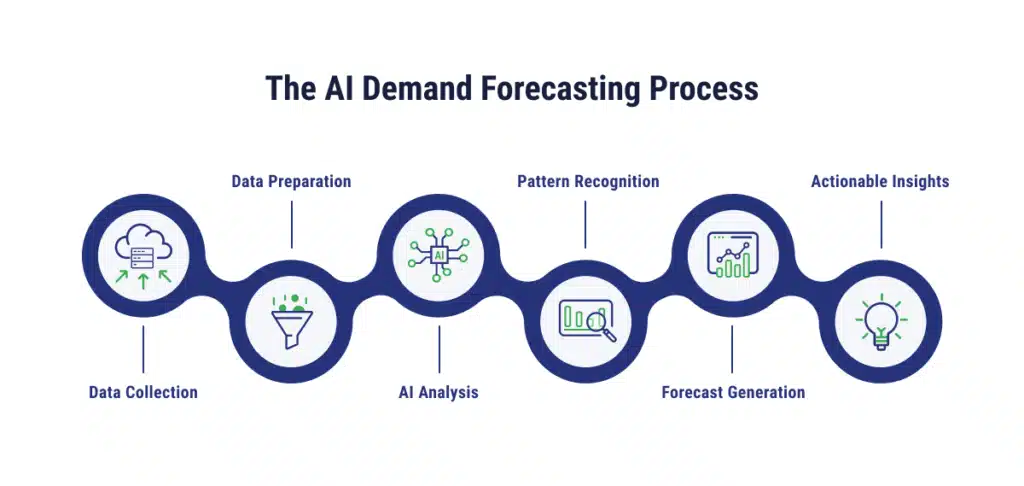
Example of AI Demand Forecasting Process (Source: TierPoint)
Take a practical Singapore example:
A sports retailer might see that running vests sell steadily year-round, but sales spike every August before the Army Half Marathon.
Traditional planning might catch that. But AI can also notice that a particular colourway is getting more early searches on your site, or that similar stores in your category are seeing faster turnover on moisture-wicking fabrics.
That means you can shift orders from standard cotton tees to technical gear before the rush hits. Better demand prediction helps you prepare earlier, order smarter, and avoid last-minute airfreight costs that eat into your margins.
Once you have better demand forecasts, the next natural question is how to balance stock so you’re never caught overcommitted or underprepared.
Reducing Stockouts and Overstocking
This is where AI stock management delivers the most visible wins for Singapore retailers.
A stockout happens when demand exceeds your available inventory. The result? Lost sales and often a permanent dent in customer trust. Overstocking is the opposite problem, cash sitting on shelves while you pay for storage you don’t need.
Let’s put it in local terms. During 11.11 or 12.12, your bestseller might sell out in hours. Without AI, you might not even notice until your customer service team starts getting angry messages.
Meanwhile, overstocking a slow-moving SKU means that precious pallet space in your warehouse could have gone to faster inventory.
AI helps you find balance:
- Continuous sales monitoring: Real-time visibility into velocity
- Lead time tracking: Know exactly when stock will arrive
- Early warnings: Alerts before bestsellers run dry
- Excess flags: Notices when you’ve ordered too much of a slow mover
The goal isn’t zero inventory. The goal is enough stock to meet demand without creating waste.
Achieving that balance also means making smarter decisions about when and how much to reorder. That’s where replenishment gets much more efficient.
Making Replenishment and Purchasing More Efficient
Most teams either reorder on autopilot, same quantities, same schedule, or scramble at the last minute when something runs out.
Neither is efficient, especially in Singapore, where lead times from regional suppliers can vary wildly.
Inventory automation changes that. AI can help you decide:
- When to reorder: Optimal timing based on lead times and demand
- How much to reorder: Quantity suggestions that minimise holding costs
- When demand is rising faster than usual: Catch spikes before they become problems
- When a supplier delay means ordering earlier: Proactive, not reactive
Consider a common local scenario. Your supplier in Thailand often delivers late before the December holiday season because of port congestion.
AI can flag that pattern based on historical data and suggest you place your November order two weeks earlier.
No more rushed decisions. No more paying for express shipping that kills your margins.
The same logic applies to daily replenishment for fast-moving consumer goods. Low-stock alerts become proactive suggestions rather than reactive alarms. That frees up your procurement team to focus on strategic negotiations instead of firefighting.
Better replenishment decisions also become easier when you have clear visibility across every location where your stock sits.
Improving Inventory Visibility Across Locations
If you run multiple stores, warehouses, or fulfilment centres across Singapore, you’ve probably faced this problem. You think you have stock, but you don’t know exactly where.
A customer orders online. Your system says you have three units. But those three units are sitting in a store at Westgate, and nobody thought to transfer them to your main fulfilment hub in Toh Guan.
Supply chain optimisation through AI helps you see stock movement clearly:
- Which location is running low: Prevent localised stockouts
- Which location has excess: Identify transfer opportunities
- Where products are sitting too long: Spot ageing inventory before it becomes waste
For omnichannel retailers juggling Shopback orders, in-store pickup, and warehouse shipping, that visibility is essential.
If one store in the east is running out of a popular item while another in the north has plenty, AI can flag exactly where inventory needs to move. You avoid unnecessary inter-store transfers and reduce the time staff spend hunting for stock.
When visibility improves across locations, another benefit follows naturally. You start wasting less time, less space, and less money on stock that never needed to be there in the first place.
Reduce Waste and Unnecessary Costs
Waste isn’t just about perishable goods, though that’s a huge concern for food and beauty retailers in Singapore’s humid climate. Waste is also:
- Seasonal items that go unsold after Chinese New Year or Christmas
- Slow movers needing steep discounts on Shopee or Lazada
- Excess stock eating up expensive warehouse rent
Smarter inventory planning helps you order closer to actual demand.
You reduce:
- Storage costs: Pay only for the space you actually need
- Unnecessary markdowns: Stop training customers to wait for discounts
- Labour hours: No more managing products that never should have been ordered
A local example:
- A small fashion brand might see AI flag that three styles of linen dresses are forecast to sit for 60 days based on early browsing data.
- Instead of ordering 200 units of each, they order 80 and run a small pre-order campaign. No dead stock. No storage fees eating into margin.
That said, AI isn’t a crystal ball. Relying on it completely comes with real risks, and knowing those limits is just as important as knowing the benefits.
Risks and the Need for Human Oversight
AI can create real problems when the data behind it is incomplete, outdated, or missing important context.
If your sales history is messy, say you changed your POS system six months ago or ran an unplanned promotion that skewed numbers, your forecasts will be messy too.
Here are key risks to watch for in a Singapore context:
- Poor data leads to inaccurate forecasts: Garbage in, garbage out
- AI may miss sudden viral trends until it’s too late
- Supplier changes aren’t always reflected: A Malaysian supplier raising prices or facing flood-related delays
- Unexpected local events break the model: Circuit breaker, haze season, or sudden travel reopening
Over-reliance on automation can also lead to automatic over-ordering or under-ordering. That’s why human oversight still matters most.
Your team knows things AI doesn’t:
- A supplier relationship that’s getting rocky
- A competitor opening nearby
- A customer trend that hasn’t hit the data yet
- Cultural or seasonal nuances AI doesn’t understand
Use AI to flag patterns and suggest actions. But keep your operations and procurement teams in the loop to handle exceptions, catch weird market shifts, and apply real-world judgment.
The best smart inventory systems combine machine speed with human common sense.
Final Thoughts
You've seen how AI for smart inventory can transform demand forecasting, reduce stockouts, and improve replenishment decisions. But theory alone doesn't move inventory. Application does.
At @ASK Training, we help Singapore professionals move from knowing about AI to actually using it. Our Generative AI courses are hands-on, practical, and designed for busy teams who need results, not just concepts.
Newly Launched:
- We launched a dedicated course on (24hrs) AI for Smart Inventory: Predictive Analytics & Optimisation.
- This new programme will dive deep into inventory automation, demand forecasting, and supply chain optimisation specifically for Singapore's retail and logistics environment.
For Organisations
- We offer customised corporate training programmes tailored to your industry, workflow, and business goals.
- Not sure where to start? We provide a Training Needs Analysis to help identify exactly which AI skills and processes will deliver the biggest impact for your organisation. Book your complimentary 15-minute consultation with us!
Have questions about which course fits your team? Speak to our programme consultants today!
Stop guessing your stock. Start letting AI guide your next move.
Related Courses
- (24hrs) AI Smart Inventory: Predictive Analytics & Optimisation
- (24hrs) AI in Operations: Enhancing Workflow Efficiency & Automation
- (32hrs) AI Driven Sales & Marketing: Boosting Engagement & Conversions
◆◆◆
Related Articles
Article Topics
- What is AI for Smart Inventory?
- Why Smarter Forecasting Matters in Inventory Management
- How AI Helps Predict Demand
- Reducing Stockouts and Overstocking
- Making Replenishment and Purchasing More Efficient
- Improving Inventory Visibility Across Locations
- Reducing Waste and Unnecessary Costs
- Risks and the Need for Human Oversight
- Final Thoughts